My last cache hide was a multi-cache hidden up on my favorite trail. It's now been hidden for over a month and has a grand total of two finds, one of which is the beta tester who went with me when I was laying out the final coordinates. 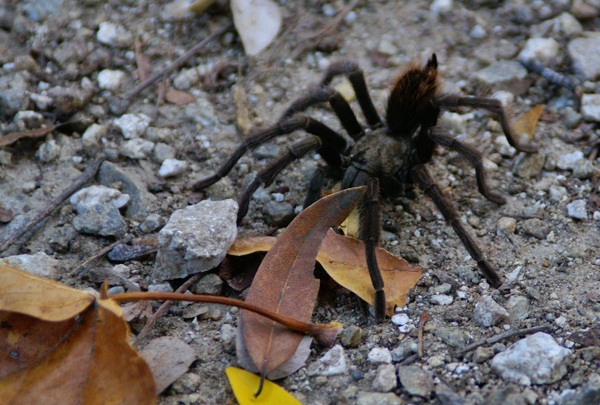
The reason why I bring this up is while on that hike, CraigsOutside and I encountered a tarantula on the trail. That's not necessarily surprising since the area is know to have tarantulas, but what is surprising is before that hike, I've seen a tarantula in the wild only one other time and it was about 2 weeks before that when I spotted two others.
One was on the trail and was actually discovered by a couple of bicyclists coming down the hill. One stopped about 50 feet up the trail from me and pointed it out to his riding partners who were behind him. By the time I got up there, it was just ambling across the fire road. Later on that same hike, I nearly stepped on one at ground zero of the first stage of my multi-cache. If that doesn't get your adrenaline up, nothing will I guess. Either that, or you're just a calmer person than I.
I've encountered my fair share of creepy crawly things while out geocaching. I've spotted snakes from time to time. Once, while out hiking we came across a very large rattlesnake. Unfortunately, it wasn't really pleased with us being there, but there wasn't a whole lot we could do about it at the time, since we had it surrounded on a couple of sides. We did the best thing we could do and that was to back up and make wide circles around it. This snake encounter was in May, when the environment is becoming more habitable for all creatures in this area, but particularly reptiles, since they rely on the air temperature for warmth.
My friend CraigsOutside was bitten last year by a rattlesnake (read about it here). 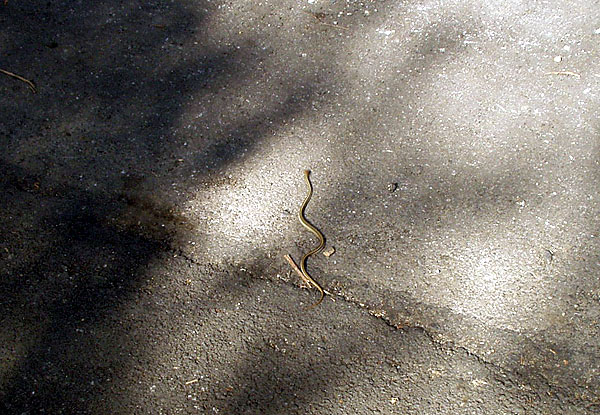
Before last year, I wouldn't have had rattlesnakes on my mind at all in November or December or any of the cold months of the year. Craig's encounter had me a lot more cautious yesterday while I was looking through a pile of rocks on the side of the road. I keep thinking that I really should get a hiking stick of some kind to carry along with me. Many of my friends take one along when we go on hikes. I've never found the need to carry one, mainly because it's one more thing in your hands while you're walking. Maybe I need to rethink that.
I'll be hiking out in the desert over the next couple of months. It's the most pleasant time to be hiking out there. It's cool and comfortable, much more pleasant than during the middle of the summer time. There's another figure out in the desert that we're going to create. I've written about the Smiley series and the Groundspeak logo in the past. Now, in the same general area to the west of the Smiley Series is a large PacMan. There are 30 caches, plus one mystery which makes up the eye of the PacMan. I have this feeling after we go out and find all of those, we might be singing "PacMan Fever" for awhile.
It appears as if each cache is about two tenths of a mile from the next cache, meaning this will be a 6 mile hike. That will make for a good hike if we do it all in one day. If we spread it out over two days, it'll be two good hikes. Anything over a mile is a good hike, in my opinion. And since one of our proposed hiking dates happens to fall on one of my open cache dates, that's always a bonus.
Pictures were taken at or near the following geocaches:
Give or Take 20ft - by madmaxxawr
Curiouser and Curiouser - by Terra Girl, Bean Dog, and my faithful sherpa Max
Sunday, December 5, 2010
Desert creatures and other things


Saturday, August 21, 2010
Better late than never?
As usual, Wile E. Coyote showed up a little late and looking a little worse for wear. My wife came home from work yesterday and saw this guy taking a snooze in the grass directly across the street from our house. The only reason it got up was because our neighbor had just walked out into the driveway and gotten in his car.
I was able to get a couple of pictures taken before this one went around the vegetation to the right in the picture and disappeared. 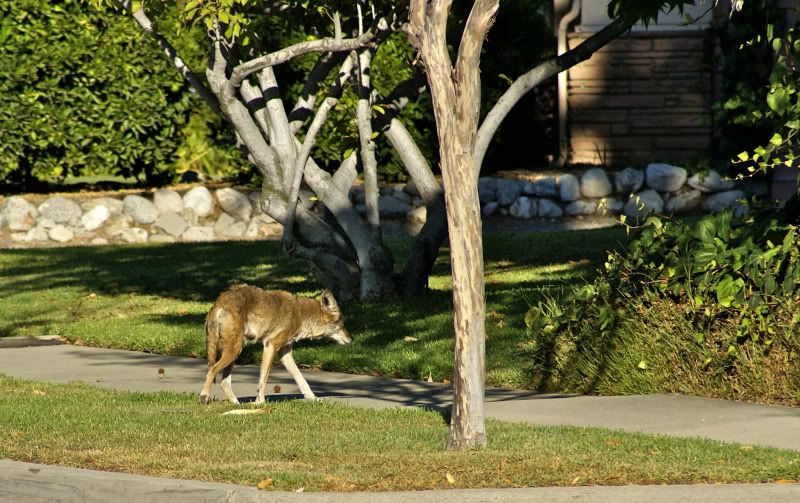
Either way, it is always important to be on the look out for wildlife, either on the trail or in urban environments. My son has informed me that he's seen the roadrunner several times on his way to and from school for cross country practice. As noted in my last post, we see coyotes all the time, but usually near dusk or dawn and they are usually fairly skittish and people wary. This one wasn't.
I've been hiking in the foothills north of our house and seen coyotes several times. One time I had been out geocaching with friends in San Dimas Canyon, located to the west of our house. We had been looking for a nicely put together geocache entitled Curiouser and Curiouser, themed after Alice in Wonderland. After finding the cache, we stood at the gate leading which closed the fire road to regular car traffic and I spotted a coyote walking toward us about 500 feet or so up the road.
As soon as the words came out of my mouth, I was thinking to myself that something didn't look right at all with that coyote. I even mentioned it out loud. At about the same time, the "coyote" made a left hand turn into the brush by the side of the trail and it was at that time that we realized that we'd been looking at a mountain lion walking toward us. In the dwindling twilight, we decided to take our leave from the area.
Be careful out there.

Tuesday, August 17, 2010
Meep! Meep!
I came home this afternoon from work to a very nice surprise in my front yard. I'd actually taken a different route home, since I was low on gas. 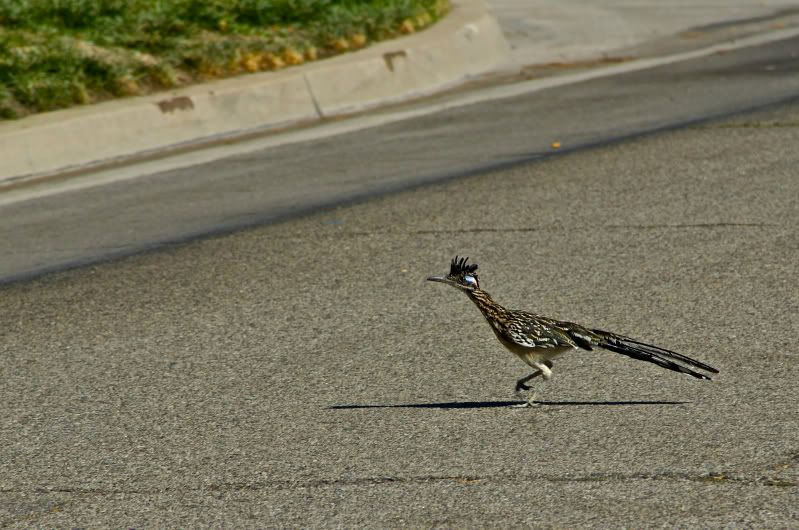
It was motionless as I drove by and pulled into the garage. I got out of the car and slowly walked out on the driveway and the bird crouched down as it was getting ready to take flight. I backed off and got a great view of a very large roadrunner. I would guesstimate its length at around 18 inches or so from beak to the end of the tail. It's a pretty distinctive bird, one that I've seen one other time in the Palm Springs area along a fairway of a municipal golf course.
According to the Wikipedia article, I live in its habitat, so I guess I shouldn't be surprised to see it running around, but I'm much more familiar with his "stereotypical" enemy, Wile E. Coyote than the roadrunner. I probably see a coyote in the neighborhood, walking down the street probably once a month, if not more. Raccoons are sometimes common, less so than perhaps skunks, but never a roadrunner before.
I quickly went inside, got my camera and started birdstalking. By the time I was back outside, he was on the curb and then in the middle of the street, heading over to greener pastures. At first I thought I was going to lose it in the neighbor's bushes, but it seemed to have a single minded purpose about it, heading over to another neighbor who has a nicely xeroscaped front yard, one that I have been thinking about creating in my own front yard.
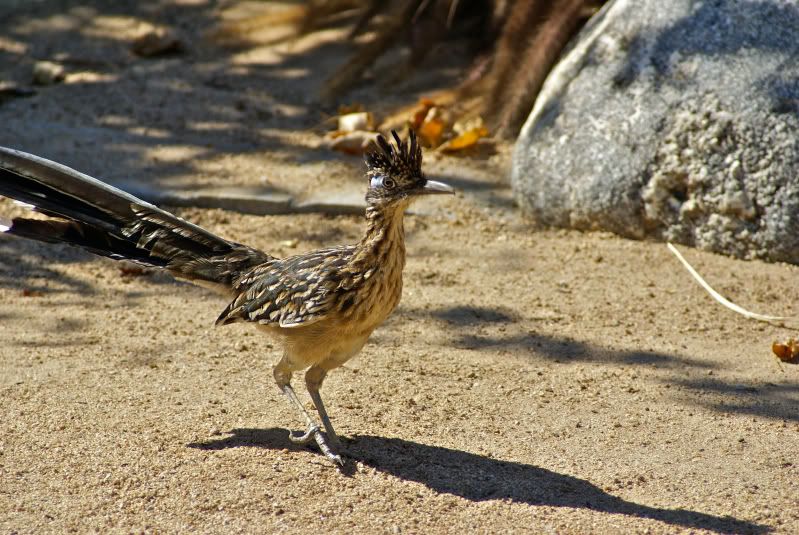
I have to admit, had I known this bird had been living in the neighborhood, I know I wouldn't have been surprised to have seen it. I get into a certain mindset because I live in an urban setting. The mindset includes not seeing much wildlife, outside of the occasional squirrel, or the multitude of birds that inhabit the trees in the neighborhood.
As noted above, coyotes are fairly regular, but they're one of those animals that have increased their range because of human existence. The ready supply of food that we tend to leave out in the form of garbage is tailor made for the coyotes, rats and raccoons of the world. But to see an obviously desert creature, in a fairly urban setting is very surprising and a nice treat. I hope to see it again in the near future.

Sunday, August 15, 2010
The Sundial Bridge
The Turtle Bay Museum in Redding, CA had a lot of nifty features about it that make it stand out as a high quality museum, one that a person would want to come back to often. 
The arboretum is connected to the museum by way of a bridge. However, this bridge isn't just any bridge, but a sundial as well. Yes, you read that right. The bridge is also a sundial. If you're driving along Interstate 5, you might think it's just a white spire, perhaps a sculpture. But when you get close to it, you can see it's a sundial. It definitely gives the city an identity.
This bridge is a pedestrian and bike bridge. There were plenty of people out on a warm Monday enjoying the sites the museum had to offer as well as the arboretum. There were some dog walkers as well as a couple of geocachers thrown into the mix as well. In my original bookmark I created for our trip up here, I noted many geocaches on the arboretum side of the museum grounds. We ended up getting the one nearest the sundial on the far side of the bridge. It was close to noon, neither of us work well when we're hungry and we didn't want to get too far afield when Chaosmanor called telling us they were there. It wasn't a problem, as it really gives us a built in excuse to come back and visit again.
The bridge, itself, is a marvel of engineering. It appears to be a suspension bridge, with the gnomon (the shadow caster) being used to support the bridge. The sundial is large enough, plus it's close enough to the Sacramento River, that it's only good for about four hours worth of time telling, from about 10 in the morning, to 2 in the afternoon, PDT. We were there at 11:48 and it was keeping remarkable time, with the shadow slightly past the 11:45 mark. We were able to get underneath the bridge and it resembles a cruise ship's mast from that particular angle.
While we were crossing the bridge, I happened to look to the west. 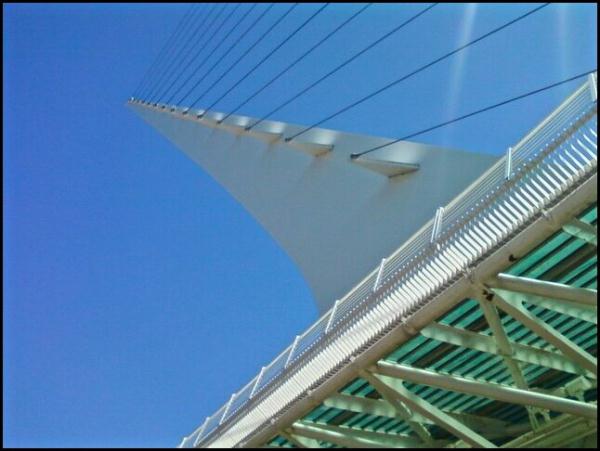
Having grown up in a time period when the eagle was in danger of extinction, it was very heartening to see this beautiful creature living in a semi-urban environment and not just in the woodsy backcountry where so few could enjoy its majesty. I looked it up and found that it has been removed from the endangered list in 1995, moving to the "Threatened" category, and in 2007, it was delisted from the "Threatened" category. This is a remarkable achievement for a bird that was on the verge of extinction in the lower 48 during my lifetime.
I would have to say seeing the bald eagle was definitely one of the highlights of the trip. I have a geocaching friend in Nebraska, who is a serious birder and keeps life lists of birds she's seen. I hope she's already experienced.
While the GPS Maze exhibit won't always be at the museum (it's scheduled to close on Labor Day), the bridge and arboretum will be there for a long time. 
Pictures were taken at or near the following geocaches:
GPS Adventures Maze Exhibit-Turtle Bay Park - by Groundspeak
Quality Time - by BlueBoyDavid

Thursday, June 24, 2010
Butterflies are free to fly

I guess you could say I'm an amateur lepidopterologist. When I see a butterfly in the field, I usually watch it for several minutes in the hopes that it will alight somewhere and pose for me so I can take a picture of it. As a youngster, I can remember watching small yellow butterflies that were very common around my house. I had been told that these particular ones were moths, but I have since learned they are actually a type of skipper.
Since I had only seen these types of insects during the day, it made sense for them to be butterflies, as they are usually active during the day, while moths tend to be active at night. And that makes it nice to take pictures of butterflies, because they're out when I'm out. Back in December, I wrote about one of the Monarch wintering grounds near Pismo Beach, California. I can honestly say I've never seen so many Monarchs in one place ever.
I can remember growing up, reading about the Monarch butterfly and thinking if I'd ever get the chance to see one. 
The interesting thing about butterfly identification is it's not an exact science. I tend to use this site as my guide when I'm trying to identify a butterfly. When I saw the Western Checkerspot on a trail hike last month, I was surprised to find that it could have been one of about four different subspecies.
There was another time while doing the Groundspeak series of caches when I spotted a pretty small green butterfly. It was late in the evening, so it was looking for a spot to rest of up for the night. When it found a spot, it folded up its wings and settled in. That didn't help with the identification, since much of the identity of a butterfly is on its top wings. The best I could do with that one was to narrow it down to either a Desert Marble or perhaps a California Marble. Once again, the identification guide is not fool proof, but it gave me a pretty good idea of what I was looking at.
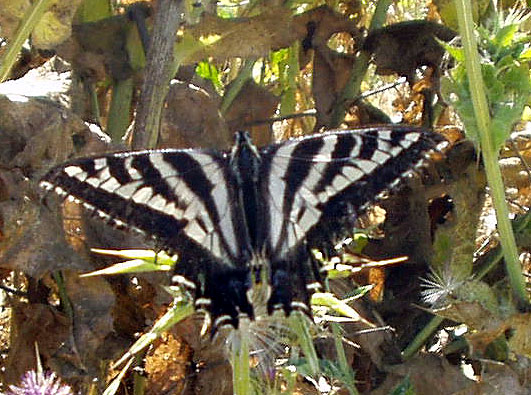
These pictures here represent just a small portion of the butterflies I've seen in my lifetime. I have not been able to photograph them all, nor will I ever. I just think they're interesting to look at and I find it kind of neat to be able to note that the swallowtail isn't just a swallowtail, but a Pale Swallowtail.
Pictures were taken at or near the following geocaches:
East Canyon Above and Beyond the Meadow - by SnakeSpotter
Micro N Post - by not tom
Carpe Diem! - by HaZaMaTt...

Thursday, April 8, 2010
Black birds, barrels and butterflies
For the most part, the desert seems to be a pretty barren place. When one thinks of the desert, usually one thinks of drifting dunes, camels and not much life. 

Pictures were taken at or near the following geocaches:
Groundspeak Series - Stealth - by HDGC
Groundspeak Series - Lifeline - by HDGC

Friday, March 26, 2010
Dry Bones
No matter how prepared you are, the desert can be a pretty inhospitable place. We had cell phones, we had plenty of water so we weren't really worried about ourselve, yet we found evidence in our last couple of weeks out in the desert that it can still be cruel to those that don't have these luxuries.
I noticed from some of the other logs that are appearing on some of the caches we found the first weekend out at the Groundspeak series that several of the cachers found the same thing as we did; dried out bones. The first thing I noticed as we approached the cache was a pelvis, bleached by the sun, completely free of any sinewy material that would indicate that it hadn't been out there for a long time. These bones were picked clean, so they'd definitely been out there for awhile.
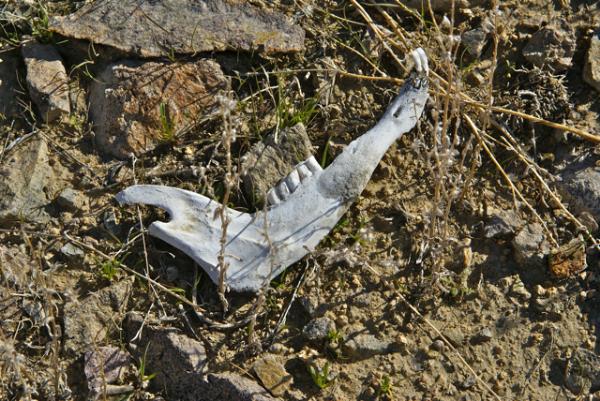
Near the pelvis, we found two sections of vertebrae, fairly intact and two long bones, what I thought to be thigh bones. The sizes of the long bones gave me the impression that this particular animal was probably a coyote. But then, we found a jawbone which messed up those theories post haste.
The jawbone was of a herbivore. Cutting teeth in the front, with molars in the back for chewing, with no canines for ripping like you'd see with a carnivore or possibly an omnivore like a desert wild pig. The size indicated a deer, but I was puzzled since deer aren't usually found here. Yes, you will see them, but they're usually found at higher elevations where the food is a lot more plentiful.
There were a lot of green plants around, but it's spring time in the desert and it's expected that green plants will be around. They will flower soon, produce their seeds which will be scattered by the wind and then they will die, only to come back after the winter rains. There is not much food during most times of the year out here, so it still didn't make sense. 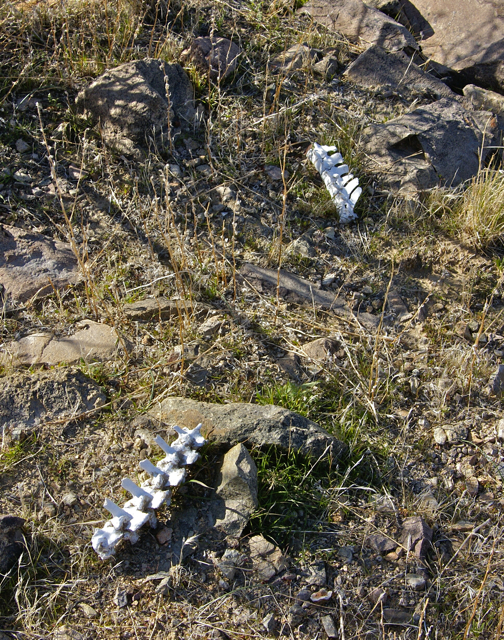
Whatever the possibility, it gave us a reminder that most animals don't have the luxuries that we have when it comes to our health. Death in the wild, is usually not pretty and I would suspect that very few animals die a peaceful death. The animals get recycled quickly as is the way with nature, so that they will give back to the plants what they took from them when they were living. How long these particular bones had been out there is anyone's guess. My hope is they stay for a longer period of time and aren't picked up by others as they hike through the desert. Let the sleeping bones lie.
Pictures were taken at or near the following geocaches:
Groundspeak Series - Power Caching - by HDGC